
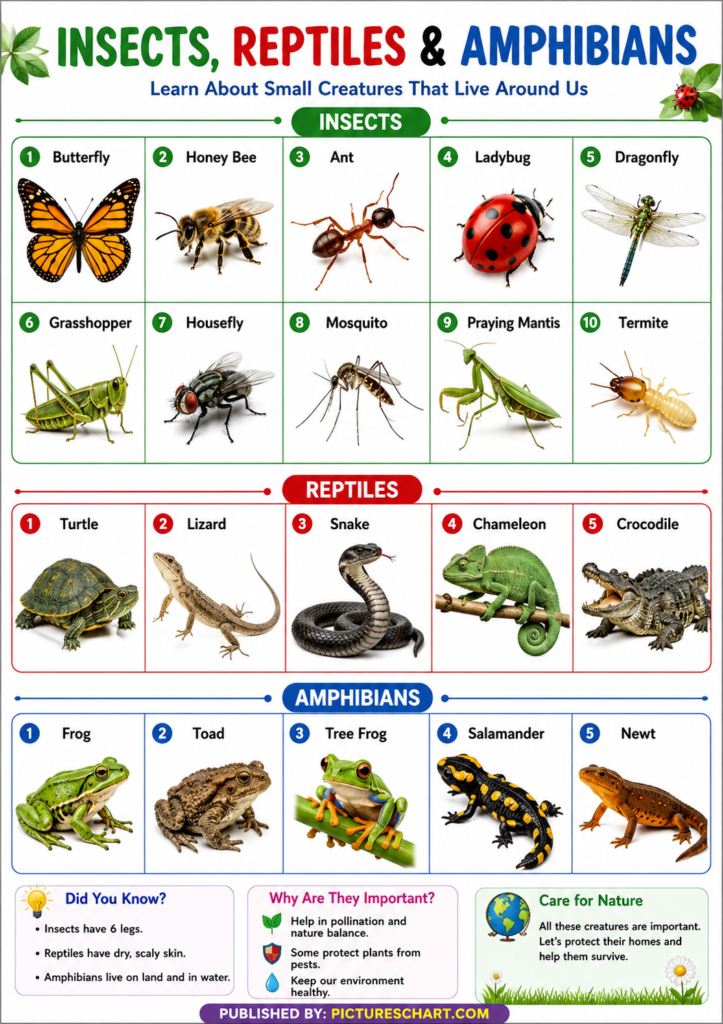
Insects, Reptiles & Amphibians Chart
Learn About Insects, Reptiles and Amphibians with Pictures
The Insects, Reptiles & Amphibians Chart helps children learn the names and basic features of small animals through colorful pictures. It is useful for preschool, kindergarten, primary school, teachers, parents, and classroom activities.
What Are Insects?
Insects are small animals with:
6 legs
3 main body parts
Many have wings
Most lay eggs
Examples include butterflies, ants, bees, and dragonflies
Insects in This Chart
Butterfly
Honey Bee
Ant
Ladybug
Dragonfly
Grasshopper
Housefly
Mosquito
Praying Mantis
Termite
What Are Reptiles?
Reptiles are animals that usually have dry, scaly skin. Many reptiles lay eggs and live on land, although some spend much of their time in water.
Reptiles in This Chart
Turtle
Lizard
Snake
Chameleon
Crocodile
Quick Facts
Turtle: Has a hard protective shell.
Lizard: Has a long tail and scaly skin.
Snake: Has no legs and moves by sliding.
Chameleon: Some species can change their skin color.
Crocodile: Strong swimmer with powerful jaws.
What Are Amphibians?
Amphibians are animals that can live in water and on land during different stages of their lives.
Amphibians in This Chart
Frog
Toad
Tree Frog
Salamander
Newt
Quick Facts
Frog: Excellent jumper and swimmer.
Toad: Usually has dry, bumpy skin.
Tree Frog: Often lives in trees and plants.
Salamander: Has a long body and tail.
Newt: Small amphibian related to salamanders.
Insects vs Reptiles vs Amphibians
| Group | Main Features | Examples |
|---|---|---|
| Insects | 6 legs, 3 body sections | Butterfly, Ant, Bee |
| Reptiles | Scaly skin, usually lay eggs | Snake, Lizard, Turtle |
| Amphibians | Life connected to water and land | Frog, Toad, Newt |
Why Are They Important?
Help maintain nature’s food chain.
Bees and butterflies help pollinate plants.
Some insects help break down dead plants and animals.
Reptiles help control populations of other animals.
Amphibians are important parts of freshwater ecosystems.
Every group has an important role in nature.
Fun Facts
A butterfly starts life as a caterpillar.
Honey bees make honey from flower nectar.
Ants live together in colonies.
Dragonflies are excellent flying insects.
Some lizards can lose and regrow their tails.
Snakes do not have legs.
Frogs begin life as tadpoles.
Some salamanders can regenerate body parts.
Crocodiles are excellent swimmers.
Many amphibians have moist skin.
Fun Quiz
Which insect has six legs?
Answer: All insects, including ants and butterflies.
Which animal makes honey?
Answer: Honey Bee
Which reptile has a hard shell?
Answer: Turtle
Which reptile has no legs?
Answer: Snake
Which animal changes from a tadpole into an adult?
Answer: Frog
Which amphibian can live in trees?
Answer: Tree Frog
Fun Learning Activity
Ask children to identify:
An insect that can fly
An insect that makes honey
A reptile with a shell
A reptile without legs
An amphibian that jumps
An amphibian that lives in trees
Why Should Kids Learn About These Animals?
Builds science vocabulary.
Improves observation skills.
Helps children understand nature.
Encourages curiosity about animals.
Makes classroom science more engaging.
Frequently Asked Questions
What is an insect?
An insect is a small animal with six legs and three main body sections.
What is a reptile?
A reptile is an animal generally characterized by dry, scaly skin.
What is an amphibian?
An amphibian is an animal whose life cycle is associated with both water and land.
Is a frog an amphibian?
Yes. Frogs are amphibians.
Is a snake a reptile?
Yes. Snakes are reptiles.
How many legs does an insect have?
An insect has six legs.
Related Charts
- Animal Chart (Wild)
- Domestic Animals Chart
- Bird Chart
- Fish & Aquatic Animals Chart
- Flowers Chart
- Plants Chart
- Medicinal Plants Chart
- Trees & Leaves Chart